






By Raj Brar, Founder of Argus AI Labs
Most companies know the value of what they sell. They can account for
their equipment, inventory, contracts, revenue and physical
property.
What they often cannot see is the proprietary knowledge their
business has been creating for years.
It exists in customer behavior, operational decisions, transactions,
failures, repairs, negotiations, documents, processes and outcomes. It
includes what worked, what did not, what changed and what experienced
people learned along the way.
That knowledge may be one of the most valuable things the company
owns. But if it remains scattered across databases, software platforms,
documents and individual memory, the company may not even know it has an
asset.
The knowledge exists. The asset has not yet been created.
This is how I have come to look at the opportunity in front of
businesses today. As an intelligence architect, I am not primarily
interested in how much data a company has. I want to know what that
company has learned through years of operating—and whether that
knowledge exists anywhere beyond disconnected records and individual
experience.
A business
can contain an asset larger than itself
What caught my attention was not simply the size of the valuations
that have begun to emerge. It was what had been valued. These companies
had taken knowledge produced through ordinary operations and transformed
it into something identifiable, defensible and economically useful.
The airline industry offers a striking example.
In 2020, United Airlines disclosed an estimated valuation of
approximately $21.9 billion for its MileagePlus loyalty business. At the
time, United’s public market capitalization was approximately $14.5
billion. The information-rich business inside the airline was therefore
valued at roughly one and a half times the market value of the airline
itself.
United subsequently completed $6.8 billion in financing secured by
MileagePlus-related assets.
The lesson is not that passenger data alone was worth $21.9 billion.
MileagePlus combined decades of proprietary knowledge about travel
patterns, purchasing behavior, customer value, loyalty and responses to
incentives with partnerships and a commercial system capable of
repeatedly applying that knowledge.
The airline had not merely accumulated records. It had built an asset
around what it uniquely knew.
John Deere reveals the same principle in a completely different
industry. Every connected machine operating in a field can produce
evidence about soil conditions, planting, inputs, equipment performance
and yield. Across hundreds of millions of enrolled acres, that history
becomes proprietary agronomic knowledge that a new competitor cannot
reproduce by purchasing better software or beginning data collection
today.
The equipment produces the immediate result. The accumulated
knowledge can improve future recommendations, products and operating
decisions. Each season can make the system more useful because each
season adds evidence that did not exist before.
Bloomberg has created a similar advantage through decades of
financial information and market relationships. Rolls-Royce has done it
by connecting engine behavior, maintenance history and operating
outcomes. In each case, the business contains knowledge created through
activities that competitors were not present to observe.
That is what makes the knowledge proprietary.
Why the asset remains
invisible
The idea that information should be treated as an economic asset is
not new. Doug Laney, who originated the field of infonomics, has spent
years showing that information can generate revenue, reduce risk and
improve performance while remaining absent from conventional financial
statements.
The accounting system is beginning to recognize the problem. The 2025
System of National Accounts introduced data as a produced asset for
national economic measurement. Corporate accounting standards, however,
still generally prevent companies from recognizing much of their
internally generated data and knowledge as an asset on the formal
balance sheet.
That distinction matters. A company can inventory, document, govern
and value proprietary knowledge for strategic planning, financing,
transactions or the creation of a separate data business even when
accounting rules do not permit it to appear as a conventional
balance-sheet asset.
McKinsey has documented what can happen when a company finally
recognizes the opportunity. A European building-materials company
converted an internal performance tool into a commercial data business
with an estimated opportunity exceeding $500 million in enterprise
value, then separated it into a subsidiary with greater autonomy.
The knowledge had been created inside the original business.
Establishing it as a distinct asset created new options for how that
knowledge could be managed, valued and commercialized.
Before any valuation can occur, the company must first establish what
it owns.
Where does the knowledge live? Who created it? What decisions does it
improve? Can it be used lawfully? Would it survive the departure of key
employees? Could a competitor reproduce it, and how long would that
take?
Until those questions are answered, proprietary knowledge remains an
unrecognized by-product of operating the business.
Possessing
knowledge is not the same as owning an asset
A company may have twenty years of transactions without having twenty
years of intelligence.
Records alone do not preserve why a decision was made, which
conditions existed at the time, what information was trusted, what
alternatives were rejected or whether the eventual outcome validated the
original reasoning.
Important knowledge is often fragmented. A customer relationship sits
in one platform. The commercial history sits in another. Exceptions live
in email. Process knowledge lives in an experienced employee’s memory.
Outcomes are recorded without being connected to the decisions that
produced them.
The company technically possesses the information, but it cannot
consistently retrieve, explain, apply or improve it.
Creating the asset means turning that fragmented knowledge into
something identifiable and manageable. It requires structure, context,
relationships, provenance, permissions and continuity through time.
It also requires governance. Knowledge that cannot be traced, trusted
or lawfully used may create liability rather than value. The asset is
not every piece of information the company has collected. It is the
proprietary knowledge the organization can understand, control and put
to work.
The
intelligence layer makes proprietary knowledge operational
This is where AI changes the opportunity.
The same foundation models are increasingly available to every
company. Access to a model is therefore unlikely to remain a durable
competitive advantage by itself.
The deeper advantage is what the system knows that a competitor’s
system does not—and whether that knowledge improves through use.
An intelligence layer connects the company’s sources, operating
context, relationships, decisions and outcomes. It allows the
organization to move beyond storing information or generating isolated
answers. It creates a controlled path through which proprietary
knowledge can be found, tested, applied and preserved.
I have encountered this problem repeatedly in discovery work with law
firms. Legal is one of the highest-barrier environments because the
knowledge is rarely contained in documents alone. It also lives in the
judgment of experienced partners: how they interpret a particular
authority, recognize an exception, connect facts across matters and
determine what applies in a specific situation.
In some firms, certain partners had developed proprietary knowledge
over many years and then left. The documents remained, but part of the
firm’s intelligence left with the people who understood how to interpret
and apply them. The firm had helped create that knowledge through years
of matters, research and decisions, yet it had never established the
knowledge as an institutional asset that could survive the departure of
an individual.
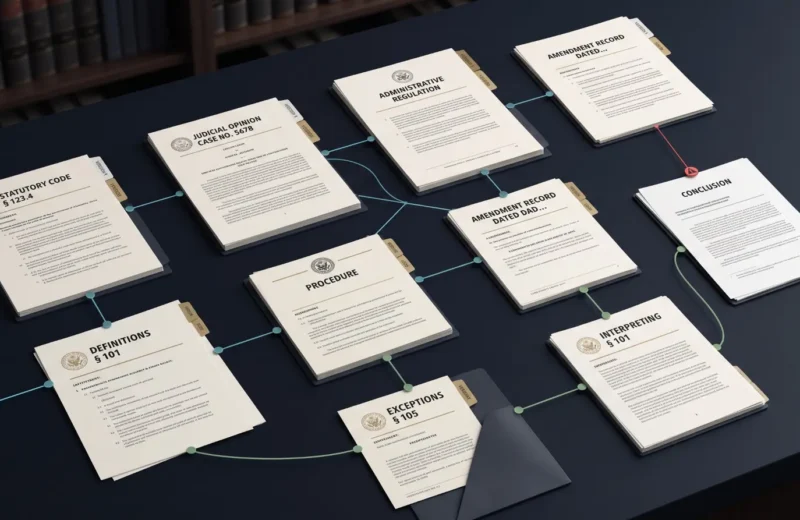
That problem became concrete in my work architecting NEXOSAT, a legal
intelligence system for Mexican fiscal law. The source documents were
publicly available, but availability was not the same as intelligence. A
legal provision could be authentic and appear relevant while no longer
being applicable. Meaning depended on authority, relationships,
effective dates, exceptions and the facts surrounding the question.
The work was not simply putting legal documents into an AI model. It
required an architecture capable of preserving where knowledge came
from, connecting related authorities, determining what applied at a
particular time and exposing the evidence behind an answer.
NEXOSAT reinforced something I now carry into every intelligence
project: proprietary knowledge does not become an asset because it has
been stored. It becomes an asset when the organization can reliably
understand, govern and apply it.
The model is one component inside that architecture. It is not the
asset.
The asset is the organized body of proprietary knowledge and the
governed process through which the organization learns from it.
This is the difference between buying AI and building
intelligence.
Recursive learning
increases the value
Once proprietary knowledge has been established as a managed asset,
the next question is whether its value remains static.
It should not.
Every new transaction, customer interaction, operational exception
and decision can produce additional evidence. When the resulting outcome
is captured and connected to the decision that preceded it, the system
can determine whether its prior understanding was correct, incomplete or
wrong.
That learning returns to the knowledge base and improves the next
decision.
This is recursive learning: the company acts, observes the result,
validates what it learned and feeds that learning back into the
system.
The important word is validated. A system that absorbs every
output without checking its quality does not compound intelligence. It
compounds error. Human review, provenance, permissions and evidence
remain essential to determining what deserves to become institutional
knowledge.
In the systems I architect, I do not treat every new output as new
knowledge. The outcome must be examined against the evidence that
produced it. If the reasoning was incomplete or the decision proved
wrong, that failure should become part of what the organization learns.
Otherwise, automation can repeat the same mistake faster while creating
the appearance of improvement.
When the loop is governed properly, the asset becomes more complete,
more useful and potentially more valuable. It becomes increasingly
specific to the organization because it reflects operating history that
competitors cannot buy or retroactively recreate.
The company no longer begins each decision from zero.
The age of proprietary
knowledge assets
Creating a separate company will not make sense for every
organization. But the underlying discipline will.
A business can identify its proprietary knowledge, establish
ownership and governance, document how that knowledge creates value,
obtain an independent valuation and decide how the asset should be
used.
That creates options.
The knowledge may strengthen the value of the existing company. It
may support a new product or revenue stream. It may become important in
financing, investment or acquisition discussions. It may remain internal
and create an operating advantage that grows more difficult to copy
every year.
But none of those options exist while the knowledge remains
invisible.
This is the work I do as an intelligence architect and the work we
are developing at Argus AI Labs. We identify the proprietary knowledge a
business has already created, preserve the context and relationships
that give it meaning, and architect governed systems through which that
knowledge can be applied, validated and improved.
We do not begin with the model. We begin with what the organization
uniquely knows—and what that knowledge could become if it were treated
as an asset.
We are entering an age in which companies will be distinguished not
simply by how much data they possess or which AI model they use. The
greater divide will be between companies that allow proprietary
knowledge to disappear inside daily operations and companies that
deliberately turn it into an asset that learns.
Your proprietary knowledge may already be worth more than your
business.
The first problem is that you may not know you have it.
The second is that, until you identify it, structure it, value it and
build a system that improves it, you do not truly own the asset it could
become.
If you believe your company may be sitting on proprietary knowledge
it has never identified or valued, that is where the conversation
begins.
Sources
- United Airlines Holdings, 2020 MileagePlus financing disclosures and
valuation materials: https://www.sec.gov/Archives/edgar/data/100517/ - United Airlines, completion of MileagePlus financing, July 2020: https://ir.united.com/
- United Nations Statistics Division, System of National Accounts
2025: https://unstats.un.org/unsd/nationalaccount/snaupdate/2025/2025_SNA_Combined.pdf - IFRS Foundation, IAS 38 Intangible Assets: https://www.ifrs.org/issued-standards/list-of-standards/ias-38-intangible-assets/
- Doug Laney, Your Company’s Data May Be Worth More Than Your
Company: https://www.forbes.com/sites/douglaslaney/2020/07/22/your-companys-data-may-be-worth-more-than-your-company/ - McKinsey & Company, From raw data to real profits: A primer
for building a thriving data business: https://www.mckinsey.com/capabilities/tech-and-ai/our-insights/from-raw-data-to-real-profits-a-primer-for-building-a-thriving-data-business - Anyscale, Learning Loops: The Path to Owning Your
Intelligence: https://www.anyscale.com/blog/learning-loops