
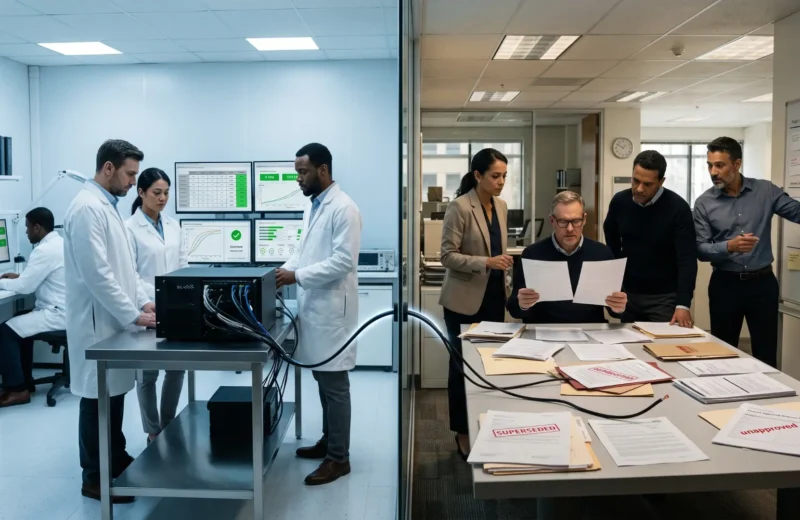




Your AI agent answered a question about your company’s regulatory obligations. The answer sounded authoritative. It cited a framework, referenced a timeline, and recommended a course of action. It was also wrong.
Not slightly wrong. Confidently, precisely, dangerously wrong — because the agent was drawing from its general training data rather than from anything your organization actually knows.
This is the hallucination problem at enterprise scale. And it is the reason that GraphRAG — graph-augmented retrieval-augmented generation — has become the architecture pattern that separates production-grade enterprise AI from expensive experiments.
The Problem with Standard RAG
Retrieval-augmented generation was supposed to solve the hallucination problem. Instead of letting a language model answer entirely from its training data, RAG retrieves relevant documents first and feeds them to the model as context. The model generates its answer based on what it retrieved rather than what it was trained on.
In practice, standard RAG works well for simple, single-hop queries. “What is our refund policy?” — straightforward retrieval, clear answer. But enterprise questions are rarely that simple. Real questions involve multiple entities, relationships between those entities, and context that spans departments and time periods.
“What approach did we use the last time a financial services client faced this type of regulatory change, who led the engagement, and what was the outcome?” That question requires the system to understand entities (client, regulation, engagement), traverse relationships (which approach connected to which outcome through which people), and synthesize context from multiple sources.
Standard vector-based RAG retrieves passages that are semantically similar to the query. It finds text that sounds related. But semantic similarity is not the same as structural relevance. Two passages can be semantically similar without having any meaningful business relationship. And two critically related pieces of information — a decision and its outcome recorded six months apart — may share almost no semantic similarity at all.
What GraphRAG Changes
GraphRAG adds a knowledge graph to the retrieval pipeline. Instead of relying exclusively on vector similarity to find relevant content, the system also traverses structured relationships between entities.
When a user asks a complex question, GraphRAG does two things simultaneously: it runs a vector similarity search to find semantically relevant passages, and it traverses the knowledge graph to find structurally connected entities and relationships. The results from both paths are merged, providing the language model with context that is both semantically relevant and structurally grounded.
The performance difference is not subtle. Research published by Lettria and AWS in late 2024 tested GraphRAG against traditional RAG on complex enterprise queries. GraphRAG achieved approximately 80% accuracy; traditional RAG achieved approximately 51%. When including partially acceptable answers, GraphRAG reached nearly 90% while traditional RAG reached 68%.
A separate benchmark published by Diffbot showed GraphRAG outperforming vector-only RAG by a factor of 3.4 on average. On enterprise-specific queries involving organizational structure, KPIs, forecasts, and strategic planning, traditional vector RAG scored near zero while GraphRAG maintained consistent performance.
Microsoft’s own research on their open-source GraphRAG implementation, tested against the VIINA dataset of thousands of news articles, confirmed that graph-augmented retrieval dramatically outperformed baseline RAG on questions requiring thematic understanding and multi-entity reasoning — what they call “global queries” about the entire dataset rather than specific point lookups.
How the Architecture Works
The GraphRAG pipeline has distinct stages that transform raw content into queryable intelligence.
First, documents are ingested and chunked into passages, similar to standard RAG. But then an additional extraction step identifies entities within those passages — people, organizations, concepts, regulations, decisions, projects — and maps the relationships between them. These entities and relationships form the knowledge graph.
The graph is organized into communities — clusters of densely connected entities that represent coherent topics or domains within the organization’s knowledge. Each community gets a summary that captures its high-level themes. This community structure enables the system to answer broad questions about overall themes and patterns, not just narrow point-queries about specific facts.
At query time, the system runs dual retrieval: vector search against the chunk embeddings finds semantically relevant passages, while graph traversal follows entity relationships to find structurally connected context. The merged results provide the language model with richer, more accurate context than either method alone.
The critical addition that makes this enterprise-grade is confidence scoring. Every piece of knowledge in the graph carries metadata: when it was validated, by whom, how frequently it has been accessed, and how recently it was confirmed. The AI agent does not just retrieve an answer — it knows how confident to be in that answer and can communicate that confidence to the user.
Why This Matters for Regulated Industries
In legal, healthcare, financial services, and professional services environments, a wrong answer is not just unhelpful — it creates liability. An AI agent that confidently cites a regulatory framework that has been superseded, or references a clinical protocol that was updated last quarter, or recommends an approach that contradicts the firm’s own established methodology, is worse than no AI at all.
GraphRAG addresses this directly because the knowledge graph is a governed, validated structure. Unlike a vector store that contains whatever was embedded, the knowledge graph contains entities and relationships that have been reviewed and approved. Provenance is explicit — every fact traces back to a source document, a validation event, and an approval decision.
This traceability is what makes AI defensible in professional contexts. When a partner asks “where did this recommendation come from?” the system can show the chain: this fact was extracted from this document, validated by this expert, approved on this date, and connected to these related decisions. That is a fundamentally different answer than “the model generated this based on similar-sounding passages.”
The Compounding Effect
The real value of GraphRAG is not static. A knowledge graph that is maintained — where new decisions are logged, new documents are processed, new relationships are mapped, and contradictions between old and new knowledge are surfaced — becomes more valuable over time.
Six months after deployment, the system knows more than it did on day one. A year after deployment, it has captured institutional knowledge that would otherwise have been lost to employee turnover, project transitions, and organizational growth. The AI agents querying that graph become more accurate, more contextual, and more valuable with every month of operation.
This is the compounding effect that separates a knowledge graph from a search engine. Search engines index what exists. Knowledge graphs learn from what happens. And that distinction is the difference between AI as a tool and AI as an institutional advantage.
Frequently Asked Questions
Q: What is GraphRAG?
A: GraphRAG is a retrieval architecture that combines traditional vector similarity search with structured knowledge graph traversal. When an AI agent receives a query, it retrieves both semantically similar passages and structurally connected entities and relationships, providing richer and more accurate context for generating answers.
Q: How much more accurate is GraphRAG compared to standard RAG?
A: Research benchmarks show significant improvements. A Lettria and AWS study found GraphRAG achieved approximately 80% accuracy on complex enterprise queries compared to 51% for standard vector RAG. A Diffbot benchmark showed GraphRAG outperforming traditional RAG by a factor of 3.4 on average.
Q: Does GraphRAG work for all types of questions?
A: GraphRAG provides the most dramatic improvements on complex, multi-hop queries that require understanding relationships between multiple entities — the types of questions common in enterprise, legal, healthcare, and financial services contexts. For simple, single-fact lookups, the performance difference over standard RAG is smaller.