Legal Healthcare Financial Services

Your Teams Are Already Using AI.
The Only Question Is Whether
You Control What Goes In.

A 30-minute executive assessment of where your sensitive data goes once AI touches it — and what's exposed right now.

410 million sensitive data violations through ChatGPT alone in 2025. Your organization is not immune.

EU AI ACT ARTICLE 50
Transparency obligations in force
since August 2, 2026
€35M
Maximum penalty per violation
or 7% of global annual turnover
HIGH-RISK DEADLINE
Full compliance required
by December 2, 2027
The Problem

Your Data Is Already Leaving.
Every Day. Without Approval.

Legal: A paralegal pastes a client contract into ChatGPT to summarize a clause. That contract now sits on external servers — in a jurisdiction your client never agreed to. Under the Heppner ruling, attorney-client privilege may already be waived.

Finance: An analyst runs portfolio models through an AI tool the firm adopted last quarter. Every input is logged by the vendor. Every output is stored. If that input contains deal terms or MNPI, the firm faces SEC exposure it doesn't know about.

Healthcare: An administrator uploads patient scheduling data into an AI workflow builder. Without a Business Associate Agreement — which no consumer AI tool offers — that's a HIPAA violation the instant the data hits the model.

None of these people did anything wrong. They used the tools available to them. The approved path was broken, so they routed around it.

Employee working late, sensitive documents leaving undetected
78% of employees using AI at work are using tools their organization never approved.
78%
of AI users at work bring
unauthorized tools
410M
DLP policy violations through
ChatGPT in 2025
$4.2M
average cost of a shadow
AI data breach
The Cost of Getting It Wrong

These Are Real Fines. From Organizations Without AI Governance.

$126M
Healthcare
Change Healthcare HIPAA settlement. Largest in HIPAA history.
$390M
Financial Services
SEC fined 26 firms in one sweep for failing to archive electronic communications.
$5M
Legal
Average law firm data breach cost.
$3.4B
US privacy fines in 2025
1 in 3
law firms breached
$10.93M
avg healthcare breach cost
The Case-Killer

A Federal Court Already Ruled.
Privilege Was Waived.

United States v. Heppner — S.D.N.Y., February 2026

A defendant used a consumer AI tool to work through his legal defense. The court held the documents were not protected by attorney-client privilege. The exchanges were treated as disclosures to a third party — and the defect sits at the moment of input. Forwarding the result to counsel later does not restore privilege. Once it was pasted in, it's gone.

When your associates paste case documents into consumer AI tools, you're not looking at a compliance risk. You're looking at the opposing party gaining access to your entire legal strategy — every draft pleading, every settlement analysis, every witness assessment. Potentially discoverable.

Privilege protection shattered by AI tool use
The Gap

Why Compliance Tools Alone Don't Solve AI Governance

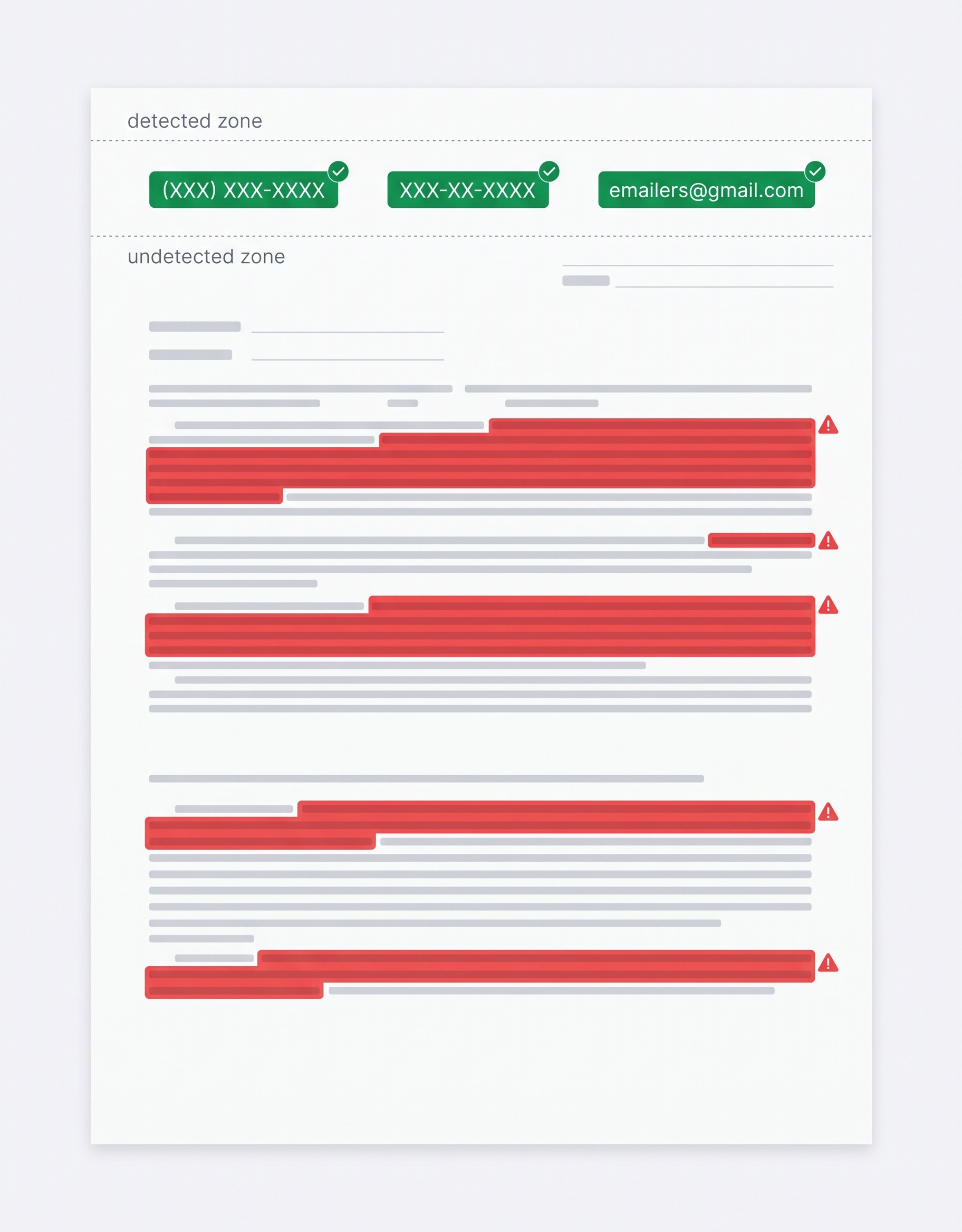
  • Regex and pattern matching catch shapes, not meaning. A standard SSN gets flagged. A sentence that says "the CFO who took medical leave for a heart condition last Tuesday" passes through completely undetected — no pattern to match.
  • Legacy DLP hits 5–25% accuracy on unstructured content. That's not a typo. 75–95% of sensitive information in natural-language documents walks through your existing defenses without triggering anything.
  • Black-box masking isn't redaction. Drawing a rectangle over text leaves the searchable text layer and metadata intact underneath. Organizations have been breached because someone covered a PDF with black boxes and considered the job done.
  • Cloud-based DLP creates the problem it claims to solve. To scan your sensitive data, these tools require it to leave your perimeter first. You're sending unredacted documents to a third-party cloud to find out if those documents are sensitive.
  • No tool checks its own work. Once flagged and masked, the output goes out. Nobody runs a second independent pass to see what survived.
A sentence like "the acquisition target is a mid-market SaaS company in the healthcare vertical — we are offering $340 million, the board votes Thursday" contains zero standard PII entities. Regex will never catch it. DLP will never catch it. That sentence is profoundly confidential.
Document showing detected zone with three small items caught, and undetected zone with five large sensitive passages missed
The Hidden Liability

Your Training Data May Already Be Non-Compliant

EU AI Act Article 10 requires that training, validation, and testing datasets for high-risk AI systems are relevant, representative, and complete — with full data lineage and provenance documentation.

Most organizations have no documentation, no bias audits, and no chain of custody for the data their AI systems were trained on. If your organization deploys AI that touches regulated decisions — hiring, credit scoring, clinical recommendations, legal research — your training data is now a compliance surface the assessment examines.

The Assessment

What the 30-Minute Review Examines

We help identify the data path, potential exposure points, and areas that may warrant closer examination. You keep the findings whether or not we work together.

$5,000
Comparable assessments from specialized advisory firms typically start at $5,000. This one is complimentary — because the conversation itself is how we determine whether there's a fit. No obligation either way.
Infrastructure Standards
ISO 27001
Information Security
ISO 9001
Quality Management
HIPAA
Health Data Protection
TISAX Level 3
Enterprise Data Handling
GDPR
EU Data Privacy

All processing runs on certified infrastructure with full chain of custody.
Compliance documentation available on request.

Your Competitors Are Arguing
Whether AI Is Governed.
Industry Leaders Are Building Governed AI.

You cannot stop your teams using AI. But you can eliminate regulatory liability, protect privileged data, and deploy auditable systems that withstand scrutiny.